 Worth Reading
The Front of the Bag Counts Seven. The Back Panel Prints Six.
Focus Mushroom Blend is three-quarters of a tablespoon of powder you stir into a cup you already make. I counted the lines on the panel, weighed each one against its own trial, and read the return page twice.

This is a paid advertisement. Sponsored by Four Sigma Foods, Inc.

Rupert Vance is the pen name of this desk.
Everything here about the bag comes from the seller's own product page, the photograph of its official panel, and its published return and contact pages, all read on September 20, 2026.
This page quotes no customers.
The reviews shown on the seller's product page belong to the whole store, and I could not find one that names this powder.
Almost everything I am sent to read comes in a bottle, and a bottle is an easy object.
You swallow it with water, and water has no opinion.
This one is a bag of powder, and a bag of powder is a different animal.
It does not get swallowed on its own. It gets stirred into a cup you were going to make anyway, which means the first honest question about it is not about milligrams at all.
The first question is what it does to the cup.
A bottle asks for a glass of water. This asks for your coffee.
The product is Focus Mushroom Blend, from Four Sigmatic, which is the trade name of Four Sigma Foods, Inc., a company with an office in Santa Monica, California.
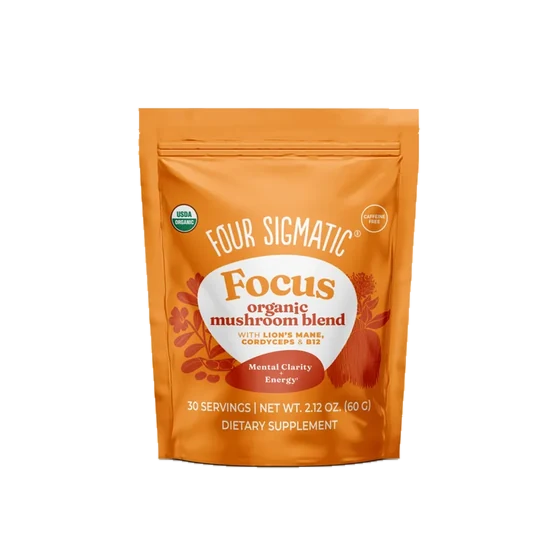
A resealable orange pouch, 2.12 ounces, sixty grams, thirty scoops.
One scoop is three-quarters of a tablespoon, which is two grams.
Five calories and two grams of carbohydrate, and no caffeine of its own.
I read the front of the bag first, the way anybody would.
The front counts seven. The back panel prints six lines and a seventh name in a place the front does not mention.
That is not fraud and it is not a scandal.
It is a front panel doing what front panels do, and a back panel doing what back panels do, and the distance between them is where this page spends its morning.
What follows is that reading, in the order I did it, and it takes a while.
Half of what matters about a powder is not a milligram at all: it is the cup, the spoon, the taste, the thirty mornings and the sentence on the return page.
Three-Quarters of a Tablespoon, and What That Actually Looks Like
Start with the amount, because the amount is the whole object and nobody looks at it properly in the aisle.
A tablespoon is three teaspoons.
Three-quarters of a tablespoon is a little more than two level teaspoons, and on a kitchen scale it is two grams.
Two grams of a dry powder is not much to look at.
It is a heaped small scoop, roughly what you would tip into a cup if you were being generous with cocoa and stingy with sugar.
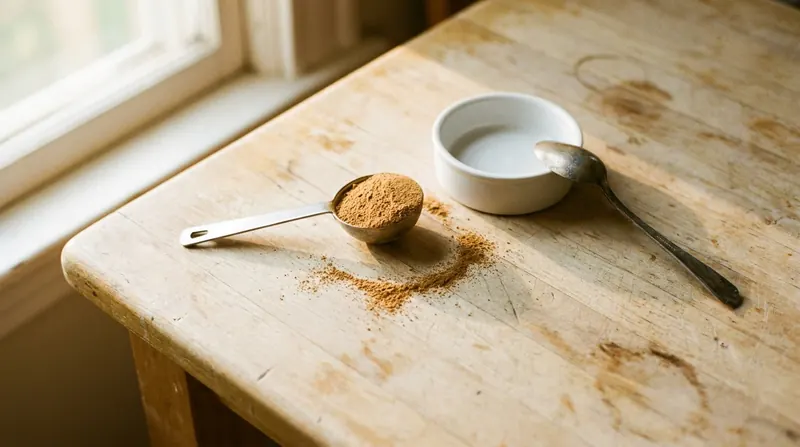
Everything on this page is for that scoop.
Every number I quote from the panel is per two grams, once a day, and if you take half a scoop you have half of every number on this page.
The seller gives you a scoop in the bag, which I appreciate more than I expected to.
A bag of powder with no scoop is a bag that invites you to guess, and guessing is how a thirty-day bag becomes a twenty-day bag.
Weigh one scoop once, on a kitchen scale, on the first morning.
If your heaped scoop is three grams rather than two, your bag is twenty mornings, not thirty, and every number on the panel is one and a half times what the label says.
That takes forty seconds and you will never have to do it again.
It is the single most useful thing in this section, and it costs nothing.
One scoop is three-quarters of a tablespoon, two grams, once a day. Weigh it once on the first morning and you will know what your own scoop is doing for the rest of the bag.
Thirty Scoops, Thirty Mornings, and the Arithmetic of a Bag
Sixty grams divided by two grams is thirty.
The bag holds thirty scoops, the label says one scoop a day, and thirty scoops at one a day is a month.
That is a cleaner arrangement than most things on this desk.
A great many bottles say thirty servings and then tell you to take two a day, which turns a month into a fortnight without ever printing the word.
This one does not do that.
Thirty scoops, one a day, thirty mornings: the bag lasts exactly as long as a bag that says thirty servings ought to last.
Hold that against the return window, which I will come to in full later on.
The seller gives you 45 days, and 45 days is longer than the bag, which sounds generous until you read what the 45 days actually cover.
Now the part that changes how you should buy it.
Thirty mornings is a real length of time, and it is also the shortest honest test of anything you stir into a cup.
The trials I am about to walk you through ran for twelve weeks, which is eighty-four days, which is two bags and four days.
One bag is not a twelve-week trial, and nobody should sell you one as if it were.
One bag is thirty mornings. The trials behind the plants ran twelve weeks.
I am not telling you to buy three bags.
I am telling you that if you buy one and feel nothing on the thirtieth morning, you have not proved anything either way, and you should know that before you pay rather than after.
The other thing thirty mornings buys you is a habit.
Whether the powder does anything or not, a scoop at the same hour every day is a small piece of structure, and structure is worth more to most men my age than any plant on the panel.
Sixty grams, thirty scoops, thirty mornings at one a day. The bag lasts a month exactly, which is honest, and a month is still shorter than every trial behind it.
The Cup It Lands In, and the Words "No Caffeine"
Here is the sentence on the front of this bag that I can check without leaving the kitchen: it contains no caffeine.
That is true of the powder, and it is the only claim on the front I can confirm for you outright.
It is not true of the cup.
The label's own direction is to add a scoop to your coffee, and coffee is the most reliably caffeinated thing in an American kitchen.
I want to be careful here, because this is not a trap the seller set.
The powder is what it says it is, and a man who stirs it into tea or into a smoothie has a caffeine-free morning; the seller is simply not responsible for what you pour on top.

But the reason a man buys a powder with no caffeine is usually that he already thinks he is drinking too much of it.
If that is you, then the scoop does not solve anything by itself, and the cup underneath it is the number worth knowing.
So here are the numbers, from the two bodies that publish them.
A twelve-ounce cup of brewed coffee holds somewhere between 113 and 247 milligrams of caffeine, and the Food and Drug Administration cites 400 milligrams a day, about two to three of those cups, as an amount not generally associated with negative effects in most healthy adults. [1]
The European Food Safety Authority puts it at the same order of magnitude.
Single doses up to 200 milligrams and daily intakes up to 400 milligrams do not raise safety concerns for healthy adults, and caffeine in moderate amounts increases alertness. [2]
Read that second half again, because it matters for this bag.
The alertness you feel after the first cup has a well-documented cause, and it is not the scoop you stirred into it.
If you add this powder to coffee and feel sharper twenty minutes later, you have learned something about caffeine and nothing at all about mushrooms.
That is not an argument against the bag.
It is an argument for one particular way of testing it, which I will lay out at the end of this page.
There is a second reason the cup matters, and it is about heat.
Nobody has told me what boiling coffee does to a plant extract dried into a powder, the seller does not say, and I am not going to invent an answer.
What I can tell you is what the label asks for.
Add a scoop to coffee, tea or a smoothie, and try it in what you bake, which means the maker is comfortable with heat and with a food processor.
The powder carries no caffeine. The coffee you stir it into carries 113 to 247 milligrams a cup, [1] and that, not the scoop, is what you will feel first.

How I Read a Front Panel
Before the six lines, the method, because you can use it on anything on that shelf and it costs nothing.
A supplement has two documents on it, and they are written by different people for different reasons.
The front is written by the marketing department, and the back is written by the regulations.
The front may count, group, adjective and enthuse.
The back must list what is in there, by name and by weight, in an order set by law.
So the method is three questions, in this order.
What does the front claim, what does the back print, and does the second one support the first?
Keep that in front of you, because everything below is asked about that list.
It is the whole declared content of one scoop, and it is a short list by the standards of this desk.
Now the front.
The front of this bag says seven adaptogens, organic, no caffeine, and a claim about focus, productivity and concentration that I am not going to repeat, for a reason I will give you in a moment.
Count the panel against that seven and you get six lines with numbers.
Lion's mane, cordyceps, cacao, bacopa, rhodiola, and vitamin B12.
The seventh name is the blueberry powder, and it is printed under other ingredients, which is the part of a panel reserved for what carries, colors, flavors or bulks the product out.
A name in that section has no amount beside it, by design, and a name with no amount is a name you cannot check.
There is a second problem with the count, and it is a definitional one.
An adaptogen is a plant that is claimed to help the body handle a load; cacao is a food and vitamin B12 is a vitamin, and neither of them is a plant claimed to do that.
So the honest count is four botanical adaptogens, one food, one vitamin, and a berry powder in the carrier section.
Seven names, yes. Seven adaptogens, no.
Does that matter?
Not enormously, and I want to be proportionate: nobody is being poisoned by a count on a front panel.
It matters because it is the first thing on the bag you can check, and it does not check out.
A front panel that rounds a count up in its own favor is a front panel whose other adjectives deserve the same arithmetic.
Six active lines with numbers, one berry under other ingredients, and two of the six that are not adaptogens by any definition. The honest count is four plants, a food and a vitamin.
The Claim I Am Not Going to Repeat
There is a phrase on the front of this bag built around the words "shown to," and I am leaving it where I found it.
"Shown to" is a specific claim in English.
It says that somebody ran a study, that the study was on this product or something very like it, and that the study came out in its favor.
I went looking for that study.
The seller cites none on the product page, none on the label, and none that I could find anywhere it publishes.
There are studies of several of the plants on this panel, taken one at a time, at amounts I am about to lay beside the label.
That is a different object from a study of this bag, and the difference is the whole of my complaint.
A study of an ingredient is not a study of a product.
Nobody has ever put these six lines together in a room full of people and measured anything.
That is the ordinary situation for almost everything on that shelf, and it would be unremarkable if the front of the bag did not say otherwise.
The same paragraph on the front carries two more words I am leaving alone.
One is an adjective about the size of the doses in the blend, which the next six sections take apart line by line, and the other is a description of what the mushrooms do to the brain, which no study on this page supports.
I also note, with some respect, what the bag does carry.
It carries the standard statement that these claims have not been evaluated by the Food and Drug Administration, which is the law for every supplement sold in this country and is printed where it should be.*
That asterisk is not a loophole.
It is the seam between describing how something supports a normal, everyday function and claiming it acts on anything a clinician would name, and every supplement in America lives on one side of it.
The front says shown to. There is no study of this bag, and the seller does not claim there is one anywhere except on the front of the bag.
Line One: Five Hundred Milligrams of Lion's Mane
This is the name on the front of the bag, and the reason most men buy a mushroom powder at all.
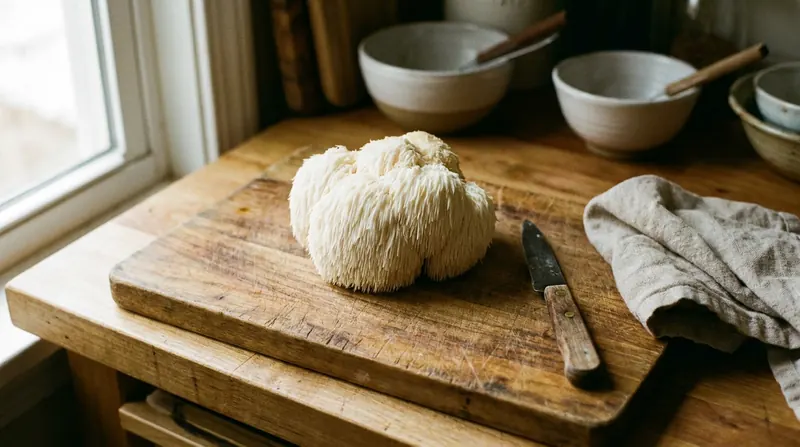
Lion's mane is a shaggy white mushroom that grows on hardwood, mostly on dead or dying beech and oak, and looks a good deal like a small mop.
It has been eaten and brewed in East Asia for a very long time, and it arrived on the American supplement shelf about a decade ago.
The panel prints 500 milligrams of an organic extract of the fruiting body, which is the mushroom itself rather than the root-like mesh it grows from.
That distinction is worth something: a good many powders are grown on grain and sold with the grain still in them, and this label says fruiting body and says no fillers, grains or carriers.
Now the trial that made this mushroom famous, and read the number carefully.
Thirty-one healthy adults over 50 took 3.2 grams a day of a lion's mane fruiting-body preparation for twelve weeks, and scored higher on a standard mental-status test than the group taking a dummy powder. [3]
Three point two grams is 3,200 milligrams.
This bag carries 500. That is a sixth of it.
A sixth of the amount, in a trial of thirty-one people.
Both halves of that sentence matter and most pages print only one.
Thirty-one people is a very small trial, it was run in Japan, the positive result was on one test, and a second measure of visual retention did not move at all. [3]
So even the trial that flatters this mushroom is a thin thing.
And this bag sits at a sixth of the amount that thin thing used.
There is a second trial worth having, because it is the one people quote when they want to talk about a quick effect.
Forty-one healthy adults aged 18 to 45 took a single 1.8-gram dose and were faster on a word-and-color task an hour later; twenty-eight days of the same supplement did not produce a result that reached significance. [4]
One point eight grams is still more than three times what is in this scoop.
And those were adults aged 18 to 45, which is not the reader this page is written for.
I want to be fair to the maker about one thing.
An extract is not the same object as the raw mushroom, and a concentrated extract at 500 milligrams is not straightforwardly a sixth of 3.2 grams of whatever the trial used, because the trial's preparation and this one are not the same material.
But the label does not print a concentration ratio and it does not print a standardization percentage.
Without one of those two numbers, nobody outside the company can convert 500 milligrams here into any amount over there, and the only comparison left to a reader is the one on the scale.
Five hundred milligrams of fruiting-body extract, against the 3.2 grams a day used for twelve weeks by thirty-one adults over 50. [3] No concentration ratio is printed, so the weight is the only comparison a reader can make.
Line Two: Two Hundred Milligrams of Bacopa
The second botanical line, and in my view the most interesting one on the panel.

Bacopa monnieri is a low creeping marsh plant with small thick leaves, used in India for a very long time and studied in the West for about twenty-five years.
It is the one plant on this panel with a body of research in adults of roughly the age this page is written for.
The panel prints 200 milligrams of organic leaf extract.
Now the trials.
Fifty-four healthy adults aged 65 and older, of whom forty-eight finished, took 300 milligrams a day of a standardized bacopa extract for twelve weeks.
They recalled a delayed word list better than the group on a dummy tablet and did better at ignoring irrelevant information; several other measures did not differ, and the most common complaint was an upset stomach. [5]
Ninety-eight healthy adults over 55, of whom eighty-one finished, took the same 300 milligrams a day for twelve weeks.
They did better on verbal learning, on acquiring new material and on delayed recall; other memory and attention measures did not differ between groups, and the extract caused more stomach complaints. [6]
A meta-analysis pooled nine placebo-controlled trials covering 518 people who took standardized bacopa for at least twelve weeks.
It found faster performance on two measures of attention speed, and its authors asked for a large, well-designed trial before anyone concludes much. [7]
Three hundred milligrams a day, for twelve weeks, twice in people of the right age.
That is the best-documented number on this page, and it is not the number on this bag.
Two hundred milligrams is two-thirds of 300, and the bag is one month where both trials ran three.
Two-thirds is closer than a sixth, and I will give the maker that.
It is still under, and the trials that exist do not tell anybody what two-thirds of the amount does, because nobody ran that arm.
There is one more thing about bacopa that belongs in the same breath as the amount.
Both trials reported stomach complaints, which is the most common reason people stop taking it, and a powder in coffee on an empty stomach is not the kindest way to meet it.
If you start this bag and your stomach objects in the first week, that is bacopa's most commonly reported effect and not a sign you are doing it wrong.
Take the scoop with food, or stop; neither the panel nor this page is worth an uncomfortable fortnight.
Two hundred milligrams against the 300 a day used for twelve weeks, twice, in adults over 55 and over 65. [5] [6] Two-thirds of the amount, for a third of the duration if you buy one bag.
Line Three: Two Hundred and Fifty Milligrams of Rhodiola
The third botanical line, and the one whose research was done in the wrong room.
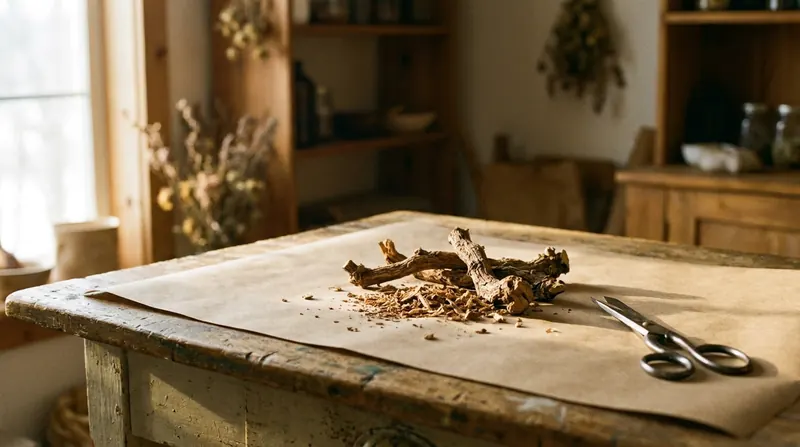
Rhodiola rosea is a low yellow-flowered plant that grows in cold, high, rocky places across Scandinavia, Siberia and the mountains of North America.
Its root has been used in those places for centuries by people doing hard work in bad weather, which is a more useful thing to know about it than most of what gets printed.
The panel prints 250 milligrams of organic root extract.
Here is the trial that gets cited for it.
Fifty-six healthy young hospital clinicians on night duty took a standardized rhodiola extract as one tablet a day in a crossover study.
Over the first two-week period they did better than placebo on tests of mental tiredness, which covered associative thinking, short-term memory, calculation, concentration and speed of perception, and no unwanted effects were reported. [8]
Read who that was.
Young clinicians, working nights, measured over two weeks, in a study whose published summary does not even give the dose in milligrams. [8]
That last detail is not a small one.
If the trial's own summary does not state the amount, then nobody can tell you whether 250 milligrams is the trial's amount, a fraction of it, or more than it.
So this line gets no mark from me, good or bad.
It is a quarter of a gram of a real plant, in a bag sold to men in their sixties, resting on a small study of young people who had been awake all night.
Being tired at 3 a.m. at 28 is not the same thing as losing a name at 66.
I am not saying rhodiola does nothing.
I am saying that the study most often attached to it measured a different state in different people, and that a page which hands you that study as if it were about you is doing something I would rather not do.
There is one practical note worth having.
Rhodiola is generally taken in the morning by the people who take it, because taken late it is the sort of plant that costs some of them a night, and a scoop that goes into the morning coffee is already on the right side of that.
Two hundred and fifty milligrams of a root whose most-cited trial ran for two weeks in young clinicians on night duty, and whose published summary gives no dose in milligrams. [8] Nothing there is about a man of 66.

Line Four: Five Hundred Micrograms of B12, and What That Percentage Means
This is the line with the biggest number on the panel, and the number is a percentage rather than a weight.
The panel prints 500 micrograms of vitamin B12, as cyanocobalamin, and beside it 20,833 percent of the Daily Value.
That figure is not a typographical error and it is not a boast; it is arithmetic.
The Daily Value for vitamin B12 on an American label is 2.4 micrograms.
Five hundred divided by 2.4 is a little over 208, and 208 times over is 20,833 percent.
Two hundred and eight days' worth of a vitamin, in one scoop.
The first thing to say is that this is not dangerous.
The office that sets these figures states that vitamin B12 has no Tolerable Upper Intake Level, because of its low potential for toxicity, and that what the body cannot use it does not keep. [9]
The second thing to say is more interesting than the first.
A very large B12 number on a label is common, and it is common because B12 is inexpensive and a big percentage looks like generosity.
So the question is not whether 208 days' worth will hurt you.
It is whether it will do anything for a man who is already getting his 2.4 micrograms from ordinary food.
Here the evidence is unusually clear, and it is not flattering to any supplement.
A review of fourteen trials covering 27,882 adults with healthy thinking concluded that B-vitamin supplements, including B12, probably have little or no effect on overall thinking at any point up to five years, and may have no effect from five to ten years. [10]
That is about as settled as this field gets.
Fourteen trials, nearly twenty-eight thousand people, and a conclusion that a supplement makes little or no difference to people who were not short of the vitamin in the first place.
Now the part that is genuinely useful, because there is one.
The same office reports that, depending on the definition used, somewhere between 3 and 43 percent of older adults living at home have low vitamin B12 on a blood test, because the stomach absorbs less of it with age. [9]
If you are in that group, B12 matters a great deal, and a supplement is not the way to find out.
A blood test is, and it is one line on a form your own clinician can add the next time you have anything drawn.
I would ask for that test before I bought this bag, not after.
If your level is fine, this line on the panel is doing nothing for you; if it is low, you want that addressed properly and not by a scoop of mushroom powder that also happens to contain it.
Five hundred micrograms, 208 times a day's Daily Value, with no upper limit set and little or no effect on thinking in a review of fourteen trials in 27,882 people. [10] [9] Ask for the blood test instead.
Line Five: Three Hundred Milligrams of Cacao
The fifth line is not an extract, not an adaptogen, and not a mushroom.
It is a food, and I think it is on the panel for a reason nobody has been straight about.
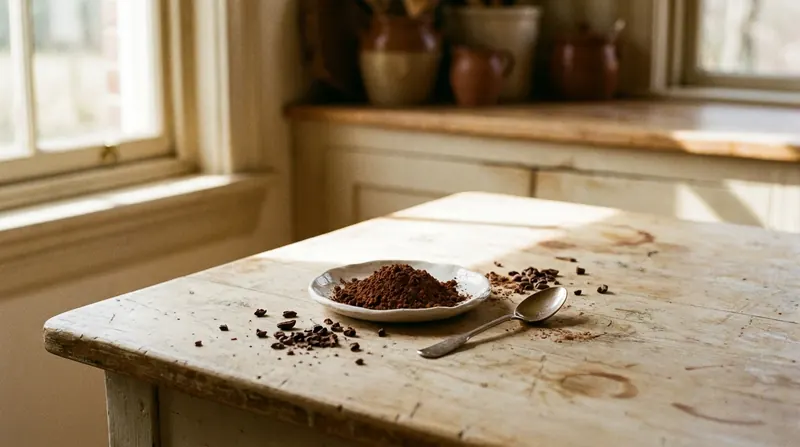
The panel prints 300 milligrams of organic cacao powder, from the seed.
Cacao is the bean that chocolate is made from, roasted and pressed and ground, and 300 milligrams of it is about a tenth of a level teaspoon.
Here is what I could not find: a trial of cacao at anything like 300 milligrams a day, on memory or attention, in healthy older adults.
The cocoa research that exists uses grams of a flavanol-rich preparation, not milligrams of ordinary cacao powder, and I am not going to borrow it for a tenth of a teaspoon.
So what is it doing there?
My honest reading is that it is doing what cacao does in any kitchen, which is making the thing taste of something.
Three hundred milligrams of cacao is a flavor, and there is nothing wrong with a flavor.
The bag says light smooth flavor, and cacao is the most plausible reason it can say that.
A blend of mushroom and root extracts with nothing in it tastes the way you would expect a blend of mushroom and root extracts to taste.
I am not complaining about this line.
A powder you have to drink thirty mornings in a row has to be drinkable, and a maker who puts a little cacao in for that reason has solved a real problem.
What I object to, mildly, is counting it as one of seven adaptogens.
Cacao is a seed people have eaten for three thousand years and it earns its place in the bag on taste alone; it does not need to be dressed up as something else.
Three hundred milligrams of cacao, about a tenth of a teaspoon, with no trial at that amount in healthy older adults. It is almost certainly there for flavor, and flavor is a good enough reason.
Line Six: Two Hundred and Fifty Milligrams of Cordyceps
The sixth and last numbered line, and the second mushroom on the panel.
Cordyceps militaris is a small orange club-shaped fungus.
The one on this panel is the cultivated species grown on a substrate in trays, which is the version essentially everything on the American shelf uses.
The panel prints 250 milligrams of an organic extract of the fruiting body.
The maker's own words for this line are about energy and endurance rather than about memory, and that is where the research such as it is has gone: toward exercise, breathing and stamina.
I went looking for a trial of cordyceps on memory or attention in healthy older adults, at any amount.
I did not find one I could put in front of you, and I am not going to describe an exercise study as if it were about names in a supermarket aisle.
No memory trial, at this amount or any other, that I could hand you.
So this line joins the saffron-shaped hole that every one of these panels seems to have.
It is a real fungus, at a real weight, with nothing behind it that speaks to the reason you clicked.
An absence of evidence gets misread in both directions, and I want to say the careful thing.
It does not mean cordyceps does nothing, and it does not mean the maker is hiding anything; it means nobody has run the study that would let anyone say.
What it does mean, practically, is that a quarter of your scoop by weight of the botanical lines is resting on a claim about stamina.
If you are buying this bag for what happens in a conversation at four in the afternoon, that quarter is not aimed at you.
Two hundred and fifty milligrams of a cultivated fungus whose research has gone toward stamina rather than memory, with no trial at this amount I could cite for a healthy adult.
Six lines read, and one name still to go.
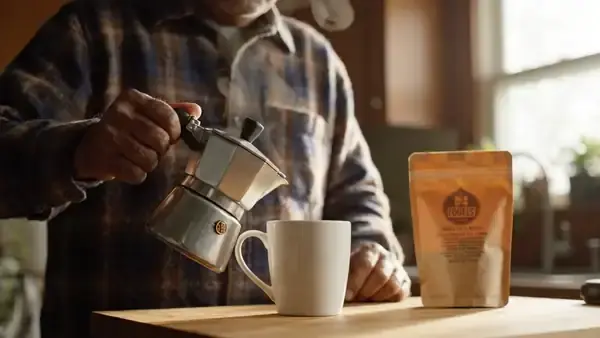
Before the name the front counts and the back sets aside, here is the bag that carries all of them, as it looks on a counter.
The Seventh Name, and Where the Panel Puts It
Now the berry, because the berry is the interesting half of the count.
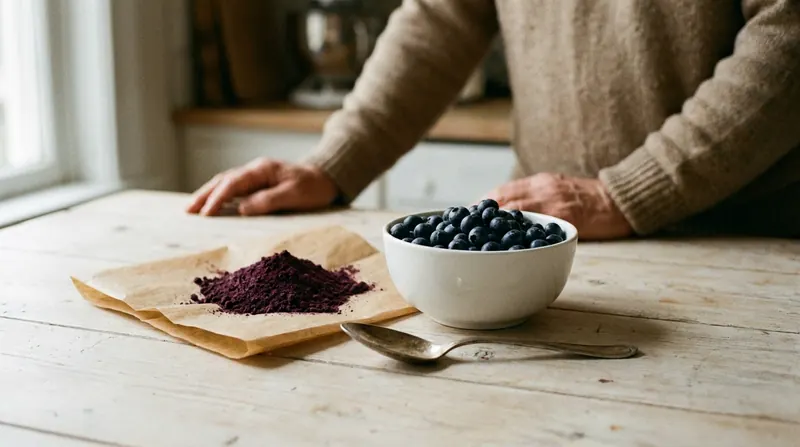
Organic blueberry powder appears on this panel under other ingredients, and it is the only name on the bag with no number beside it.
That section of a panel is where the carriers, the bulking agents, the colors and the flavors live, and nothing in it has to declare an amount.

So I cannot tell you how much blueberry is in a scoop.
Neither can you, and neither can anybody who has not seen the formula, which is the point of that section of the panel.
That would be unremarkable except for what blueberry gets called in the seller's own material, which is a claim about the berry being the brainiest of them all and a second word that I am not going to repeat.
A name in the carrier section is not the place to hang either of those.
Here is the research, so you can see the size of the gap.
In a twelve-week study of twenty-six healthy older adults, a daily blueberry concentrate providing 387 milligrams of anthocyanidins was associated with increased blood flow in the brain on a scan and a borderline improvement on a working-memory task. [11]
Three hundred and eighty-seven milligrams of anthocyanidins is a concentrate of a great many berries.
This bag does not print how many milligrams of blueberry powder it contains, let alone how many milligrams of anthocyanidins, and powder is not concentrate.
An unprinted amount of a berry, against 387 milligrams of a concentrate in twenty-six people.
I would rather see the blueberry moved up into the numbered part of the panel with a weight beside it.
Then it would be a seventh line and the front of the bag could count to seven honestly, which is a thing the maker could do tomorrow at no cost at all.
And if it were moved up, it would still not be an adaptogen.
A berry is a berry, and it is worth more in a bowl at breakfast than as an uncounted name on the back of a bag.
The seventh name sits under other ingredients with no amount, which is where a panel puts what carries, colors or flavors a product. The blueberry trial used 387 milligrams of anthocyanidins from a concentrate. [11]
Adding It Up: What One Scoop Weighs, and What Is Left Over
Here is an arithmetic nobody does in the aisle, and it takes one line.
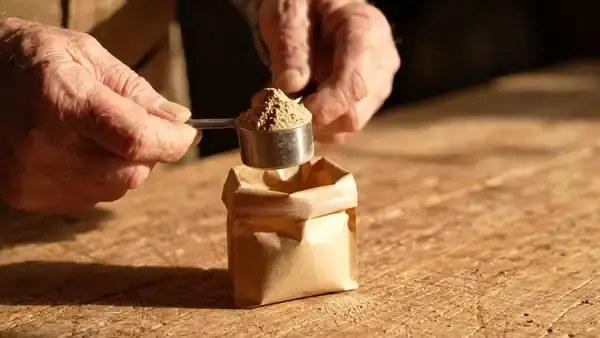
Add the six numbered lines together.
Five hundred plus 250 plus 300 plus 200 plus 250 milligrams is 1,500 milligrams, and the B12 adds half a milligram more.
One scoop is two grams, which is 2,000 milligrams.
So about 1,500 milligrams of the scoop is declared with a weight, and roughly 500 milligrams of it is the blueberry powder and whatever else makes up the rest.
That is a quarter of the scoop, by weight, that a reader cannot account for.
It is not concealed and it is not illegal; it is simply in the section of the panel where amounts are not printed.
Three-quarters of the scoop is declared by weight. The last quarter is not.
Compare that with the bottles I usually read and it is not bad at all.
A great many of them print one blend figure and a list of nine names, and this one prints a weight beside six of its seven.
That is the fairest thing I can say about this panel, and I want it on the record before the last third of this page.
Six lines with a number beside each is more honesty than most of the shelf, and the complaint I keep returning to is about the count on the front, not about the panel on the back.
The panel is a decent document.
The front is doing the selling, and the two of them do not entirely agree.

What the Label Tells You to Do With It
Three lines on this bag decide how it is actually used, and two of them are easy to skip.
The first is the direction itself.
Add one scoop to your coffee, tea or a smoothie, and try it in what you bake.
That is an unusually relaxed instruction and I take it at face value.
The maker is telling you that this is a food powder and that heat, milk and a blender are all acceptable.
The second is the flavor note, which says light and smooth.
I cannot verify a taste from a desk, and I am not going to pretend otherwise; what I can tell you is that this is the one claim on the bag you will be able to check in fifteen seconds, and the one you cannot un-check.
The third is what the label does not say, and it is the same omission I find on almost every panel.
There is no instruction about the hour of the day.
Pick your hour before the first scoop and write it down.
Ten in the morning, every morning, is a better test than somewhere between breakfast and lunch, because the thing you are trying to measure moves around during a day far more than any powder does.
One more practical line belongs here, about the bag rather than the powder.
It is a zip seal, it will be opened thirty times, and a powder that sits open on a humid counter cakes; keep it closed and keep it dry, which is ordinary kitchen sense and is not printed anywhere.
One scoop into coffee, tea, a smoothie or what you bake. No hour is specified, so pick one yourself and keep it, or the thirty mornings tell you nothing.
The Taste You Cannot Send Back
Now the return page, and this is the part of the bag I would want a friend to read before he paid.
The seller gives you 45 days.
That is longer than the bag lasts, which sounds generous, and then you read the condition attached to it.
Open food items and supplements that have been opened, or that have a broken seal, cannot be returned.
Which means the 45 days apply only to a bag you never opened.
You cannot know the taste without opening it. You cannot return it once you have.
I have read a great many return pages on this desk and that sentence is not unusual for a food product.
It is a sensible rule for a seller, it is the standard rule for anything edible, and it is also the exact rule that makes the flavor claim on the front the most consequential sentence on the bag.
So read the rest of the terms carefully, because there are three more conditions inside the 45 days.
You have to write to the seller before sending anything back, at info@foursigmafoods.com, or the return will not be refunded at all.
A qualifying unopened item is refunded at the price of the item, minus a three percent processing fee and minus the original shipping.
And the customer pays the postage to send it back.
Put those together on a single unopened bag and the arithmetic is not encouraging.
Three percent of the price, plus the shipping out, plus the shipping back, against the price of one bag of powder you have decided you do not want.
For a bag you never opened, that may well cost more to return than to keep in a cupboard.
For a bag you did open, the question does not arise, because it cannot be returned at all.
So this is not a bag you buy to try. It is a bag you buy because you have decided.
That is a perfectly honest arrangement and I have no quarrel with it, as long as you know it is the arrangement before you click rather than on the eleventh morning.
One more note on the clock.
The terms count 45 days from the initial purchase date, so a bag that sits in a hallway for a week has spent a week of it, and the clock does not care.
Forty-five days from purchase, unopened bags only, after writing first, minus three percent and minus the original shipping, with the return postage on you. Decide before you order, because the flavor is not returnable.
Santa Monica, and a Second Address in Delaware
This is the part of a listing most people skip, and the part I read first.

Four Sigmatic is the trade name.
The company behind it is Four Sigma Foods, Inc., and its terms print an office address at 1450 2nd Street, Suite 210, Santa Monica, California.
That is a real street in a real town, two blocks from the beach, in a building full of small companies.
The seller also publishes a telephone number, (855) 400-8584, and an email address, support@foursigmatic.com.
An address, a telephone number and an email, all printed by the company on its own pages, is more than a good many listings I read this month manage between them.
I have read product pages this year with a web form and nothing else, and a web form is not a way to reach anybody.
Now the oddity, because there is one and it is worth explaining rather than insinuating.
The company's own contact page prints a different address: 2711 Centerville Road, Wilmington, Delaware.
That is not a second factory and it is not a warehouse.
Centerville Road in Wilmington is one of the best-known registered-agent addresses in the United States, and tens of thousands of American companies are incorporated at it.
One address is where the people are. The other is where the paperwork is.
Incorporating in Delaware is an entirely ordinary thing for an American company to do, and a registered agent's address on a contact page is a filing detail that has escaped onto the website.
It is not a sign of anything except a lawyer being thorough and a web page being tidied less often than a filing.
I mention it for one practical reason.
If you are ever going to write a letter rather than send an email, Santa Monica is the address where somebody opens the post, and Wilmington is not.
Two addresses in public, a telephone number that connects and an email that answers. That is not evidence the powder works, and it is a very good sign about who you would be dealing with if it does not.
Why This Page Quotes No Customers
Here is the thing I want to be plainest about, because it is the sort of thing most advertising pages do quietly.
The seller's product page carries a review widget with 5,352 reviews behind it and a good-looking average.
I sat with it for a long time, and then I decided not to use a word of it.
That widget is the store's widget, not the product's.
The reviews that load under it talk about the company's coffees, about its other blends, about a probiotic; in the first pass I could not find one that names this powder at all.
Five thousand opinions about a store are not one opinion about a bag.
If I printed those reviews under a heading on this page, you would read them as reviews of the powder.
That would be a quiet lie, and it is exactly the kind of quiet lie that a page like this exists to avoid.
So there are no customer quotations on this page.
Not because the product has bad reviews, and not because nobody likes it, but because I could not separate its reviews from the store's.
This costs the page something, and I know it.
A reader who wanted to know what thirty mornings feel like for somebody else will not find that here, and I would rather leave the hole visible than fill it with somebody's opinion of a bag of coffee.
If you want that kind of evidence, you can go and look yourself.
Open the seller's page, read the reviews under the widget, and see how many of them are about this powder rather than about something else in the same shop.
Five thousand three hundred and fifty-two reviews on the product page, belonging to the whole store. None that I could find names this powder, so this page quotes none of them.

Four Things to Rule Out Before You Buy Any Powder
Before any of the six lines, there are four ordinary things that sit between a man and his own afternoon.

Not one of them is a plant, not one of them costs anything, and every one of them is a likelier explanation than a two-gram scoop.
I put them here rather than at the end because if one of them is your answer, no powder on that shelf is.
The first is water.
In a study of 1,111 adults aged 60 to 89, the third of them who were measurably short of water slipped faster on a test of processing speed than the rest, independent of their circumstances and their health. [12]
A review of eighteen studies covering 33,707 adults over 60 called the evidence tying being short of water to poorer thinking real but sparse. [13]
Sparse is the honest word for it, and it is still the only thing on this page that costs nothing and comes out of a tap.
One glass of water beside the morning cup, every morning, before you buy anything.
The second is the hour.
Most men are worse at names at four in the afternoon than they were at ten in the morning, and a man who only catches himself after lunch has measured the hour and not himself.
The third is hearing.
Straining to catch a name in a room with a television on looks exactly like failing to remember it, and the difference matters because one of those two is worth an appointment this month.
The fourth is the shape of everything you eat, over years rather than over one bag.
In a three-year trial of 604 older adults, a group eating a pattern built on vegetables, berries, nuts, whole grains, beans, fish and olive oil and a group simply eating a little less both improved their thinking scores by about the same amount. [14]
Read that result properly, because it cuts both ways.
The pattern helped, and so did plain attention to what was on the plate, and neither of them beat the other. [14]
I am not putting those four things in front of the bag to be difficult.
I am putting them there because if one of them is your answer, the bag will look as though it worked and you will pay for it for years.
Water, the hour of the day, your hearing and the shape of what you eat. [12] [13] [14] Four things that cost nothing, all of them more likely than a scoop, and all of them worth ruling out first.
Six Things a Scoop Will Not Do
- It will not come with a study of itself. Nobody has tested these six lines together in anyone.
- It will not bring the lion's mane up to its trial. Five hundred milligrams against the 3.2 grams of a twelve-week trial in adults over 50. [3]
- It will not reach the bacopa amount either. Two hundred milligrams against the 300 used in both trials in adults over 55 and over 65. [5] [6]
- It will not tell you how much blueberry you took. That name sits under other ingredients with no amount printed.
- It will not do anything a vitamin already does for you. A review of fourteen trials in 27,882 people found little or no effect from B vitamins on thinking. [10]
- It will not be returnable once it is open. The 45 days apply only to a bag with the seal intact.
If that list irritates you, I would rather you were irritated now than on the thirtieth morning with an empty bag and no idea what happened.
If You Do Buy It: One Bag, One Cup, One Notebook
If you are going to try it, try it the way you would try anything else: with a beginning, an end and something written down.
- Buy one bag, not three. Thirty scoops is a short test and that is all a bag is.
- Weigh one scoop on a kitchen scale on the first morning. If yours is three grams, the bag is twenty mornings and every number here is larger than the label says.
- Pick one hour and hold it for all thirty mornings. Ten o'clock every day tells you something; somewhere between breakfast and lunch tells you nothing.
- Put it in the same cup every day, with the same amount of coffee or tea in it. Change the drink and you have changed the test.
- Take the first week's scoops with food. Bacopa's most commonly reported complaint is an upset stomach. [5] [6]
- Ask your own clinician for a B12 level before you start, if nobody has checked it in a few years.
- Write one line a day, and write about the work rather than the feeling. What you were doing at your chosen hour, and how it went.
- Change nothing else in the same month. If you also cut the second cup or start walking, the notebook cannot tell you which one did it.
- On the last morning, read your thirty lines beside thirty lines from the month before you started. That is the only study of this bag you will ever get.
Look at that list the way I do.
Eight of the nine things on it cost nothing at all.
The notebook is the part everybody skips, and it is the part that turns thirty mornings into an answer instead of an impression.
Thirty lines in your own handwriting are worth more than any page on the internet about this powder, including this one.

Who This Pouch Suits, and Who Should Walk Past It
This is worth a look if:
- You already drink something hot every morning at the same hour, and adding a scoop to it costs you no new habit.
- You would rather take six things you can name than eleven things you cannot.
- You have read that the lion's mane is at a sixth of its trial and the bacopa at two-thirds, and you still want to see what thirty mornings feel like.
- You want a powder with no caffeine of its own, and you know the coffee underneath it still has plenty. [1]
- You like that the company prints a street address, a telephone number and an email, and answers all three.
- You have already looked at the water, the hour and your hearing, and this is the next thing you want to try rather than the first.
Give it a miss if:
- You wanted the lion's mane at the amount of the trial. Five hundred milligrams is a sixth of 3.2 grams. [3]
- You wanted a trial of this blend in men your age. There is not one, and there is not going to be one soon.
- You want to taste it before you commit. You cannot: the flavor is only knowable by opening the bag, and an opened bag cannot be sent back.
- Your stomach has objected to bacopa before. Both trials reported stomach complaints as the most common one. [5] [6]
- You were counting on the B12 to do something. A review of fourteen trials in 27,882 people says otherwise for people who are not short of it. [10]
Where It Is Sold, and What That Tells You
The bag is sold by Four Sigma Foods, Inc. on its own American store, and that is the only place this page sends you.
The company publishes a street address in Santa Monica, a filing address in Delaware, a telephone number and an email, and it answers on all of them.
None of that is a claim about the six lines on the panel; all of it is a fact about who takes the call when something goes wrong.
I separate those two things on purpose, every time.
A company can be easy to reach and straight about its addresses and still count to seven on the front of a bag that prints six lines on the back, and this one does both.

Buy one bag.
Thirty scoops is a test, and the kitchen scale comes first.
Read the panel you get, then read the thirty mornings you had.
Every line printed on this panel, with its plain English name, the amount the bag declares and the trial behind it, is written out in full in the ingredient guide linked at the foot of this page.
That guide also carries the cautions, the references and the disclosures this page is required to make.
Thirty scoops, from the people who blend them
Three-quarters of a tablespoon of mushroom, cacao and herb powder stirred into your coffee, with no caffeine of its own, from a company in Santa Monica.
SEE THE POUCH AND THE PRICESold by Four Sigma Foods, Inc., Santa Monica, California · 2.12 oz (60 g) pouch · 30 scoops of three-quarters of a tablespoon · 45 days from purchase, unopened bags only, after writing to the seller first
What men ask me over the counter
Is this medicine?
No. It is a dietary supplement: a food powder of six declared lines that you stir into a drink.
How long does one bag last?
Thirty mornings, at one scoop a day. Sixty grams divided by a two-gram scoop is thirty exactly.
Which line has the best support?
The bacopa. Its trials used 300 milligrams a day for twelve weeks in adults over 55 and over 65; this bag prints 200. [5] [6]
Is there really no caffeine in it?
None in the powder. There is plenty in the coffee you are told to stir it into, between 113 and 247 milligrams a cup. [1]
What is the 20,833 percent on the B12 line?
It is 500 micrograms against a Daily Value of 2.4, which is about 208 days' worth. There is no upper limit set for B12. [9]
What if I do not like the taste?
You are keeping it. The 45-day return covers unopened bags only, with the seal intact.
Why are there no customer reviews on this page?
Because the reviews on the seller's page belong to the whole store, and I could not find one that names this powder.
How much does it cost?
This page prints no price. The seller sets it, it changes, and a price printed here would be stale within a week.
From the Front Panel to the Cup, in Short
- A 2.12-ounce pouch of powder from Four Sigma Foods, Inc. of Santa Monica: thirty scoops of three-quarters of a tablespoon, two grams each, five calories and two grams of carbohydrate.
- The front counts seven adaptogens; the back prints six lines with weights, two of which are a food and a vitamin, plus a berry under other ingredients with no amount.
- Lion's mane: 500 milligrams against the 3.2 grams a day used for twelve weeks by thirty-one adults over 50. [3]
- Bacopa: 200 milligrams against the 300 a day used for twelve weeks in adults over 55 and over 65, with stomach complaints the commonest side effect. [5] [6] [7]
- Rhodiola: 250 milligrams of a root whose most-cited trial ran two weeks in young clinicians on night duty and states no dose in milligrams. [8]
- Vitamin B12: 500 micrograms, 208 days' worth, with little or no effect on thinking in a review of fourteen trials in 27,882 people. [10] [9]
- Cacao and cordyceps: 300 and 250 milligrams, neither with a memory trial at that amount that I could cite.
- Blueberry powder: no amount printed, against 387 milligrams of anthocyanidins from a concentrate in a twelve-week study of twenty-six older adults. [11]
- No caffeine in the powder; 113 to 247 milligrams in the cup it is meant to go into. [1]
- Forty-five days to return it, unopened bags only, after writing first, minus three percent and minus the original shipping, with the postage back on you.
- An office address in Santa Monica, a filing address in Delaware, a telephone number and an email, all published by the company.
- No customer quotations here: the 5,352 reviews on the product page belong to the whole store.
- Before any of it: water, the hour of the day, your hearing and the shape of what you eat. [12] [13] [14]
What One Scoop Is Actually Worth
Here is the whole thing in one breath.
This is a well-made food powder with six declared lines, four of them plants, from a company that grows none of them and is completely straightforward about who it is and where it sits.
Not one of the four plants is at the amount of its own trial, and the two closest to it are at two-thirds and a sixth.
The front of the bag counts to seven and the back prints six, which is a small thing and tells you which document is doing the selling.
And the thing you would most want to know before paying, which is whether you can drink it thirty mornings in a row, is the one thing the return policy will not let you find out at the seller's expense.
If you are a man who already makes the same cup at the same hour, who will buy one bag and write thirty lines about it, and who has already dealt with the water and the hour and the hearing, that is worth thirty mornings.
Not because of a count on a front panel.
Because you will know exactly what is in the scoop, exactly how far each line sits from the trial behind it, and exactly what the cup underneath it was doing all along.
Buy one bag, weigh the first scoop, pick your hour, keep the same cup, and write one line a day. Thirty mornings in a notebook will tell you more than this page can.
One pouch of thirty, at the blender's own counter
Three-quarters of a tablespoon of mushroom, cacao and herb powder stirred into your coffee, with no caffeine of its own, from a company in Santa Monica.
SEE THE POUCH AND THE PRICESold by Four Sigma Foods, Inc. · Santa Monica, California · 60 g pouch, 30 scoops, no caffeine in the powder · 45 days from purchase, unopened bags only
P.S. If you carry one thing away from this page, carry the two numbers.
Five hundred milligrams of lion's mane, which is a sixth of its trial.
Two grams in the scoop, of which about 1,500 milligrams is declared by weight and the rest is not.
P.P.S. If the afternoon haze has been with you for a year, and it is there before the first cup too, talk to your own clinician before you buy anything.
A bag of powder was never going to answer a question a clinician answers in fifteen minutes and a blood test.